Hydrocyclone (XC, XHCV and XN Series)
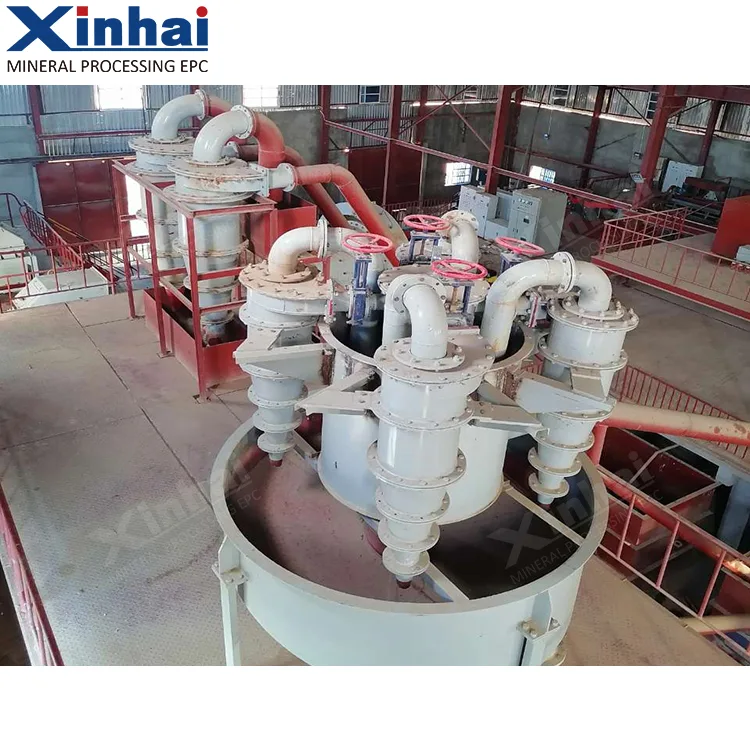
A hydrocyclone uses centrifugal force to separate fine and coarse particles. Slurry fed under pressure creates a swirling flow. Coarse particles exit the underflow; fine particles leave through the overflow. The cut size depends on pressure, density, and cyclone geometry.
Range and configuration
Typical duties include closed-circuit grinding with ball mills, desliming ahead of flotation, thickening, and multi-stage classification. Multiple units are often arranged in parallel to match circuit throughput.
The tables list the full size and type range of XC, XHCV, and XN hydrocyclones. These data show the available configuration space, not a performance guarantee for any single machine. Cut size and throughput shift together with feed pressure, density, and size distribution. A specific selection always requires a duty-based calculation.
- XC I series
- XC II series
- XC III series
- XHCV series
- XN series
Where it is used
- Closed-circuit classification with a ball mill
- Desliming, thickening and pre-classification
- Multi-stage particle size control
- Cyclone clusters in parallel to match throughput
Cut size and throughput are simultaneously affected by pressure, density, size distribution and cyclone geometry. No single throughput range can be quoted independently of the duty.
Selection fields to confirm
Before a hydrocyclone model can be fixed, the process engineer needs to define the target cut size, feed pressure range, expected throughput, and slurry density. Liner material is selected based on wear conditions. The cyclone diameter and spigot sizes are then chosen from the series table to satisfy those constraints.
- Cylinder diameter
- Inlet, vortex finder and spigot dimensions
- Feed pressure
- Throughput
- Cut size
- Overflow fineness and underflow density
- Lining material
ISO 9001 / ISO 14001 / ISO 45001 / ISO 9712 / CE / CSA W47.1 / CNAS accredited laboratory
Send the duty, get a sized proposal
Tell us the ore, the throughput and the target product. Our process engineers come back with a flowsheet position, a model shortlist and the testwork we would need to confirm it.