Ball Mill (Grid, Overflow and Dry Types)
A horizontal rotating cylinder lifts steel balls and ore. Cascade and impact break particles into finer sizes. The grinding path converts run-of-mine or crushed feed into a milled product suitable for classification or further processing.
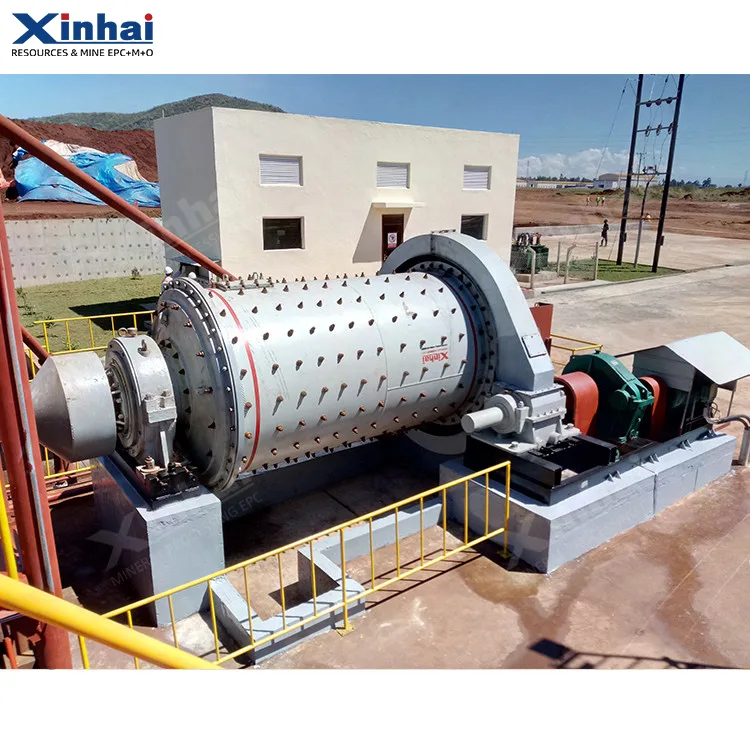
Range and configuration
Most circuits place a wet grid mill in primary grinding where rapid discharge prevents overgrinding. Overflow mills serve secondary or regrind duties when a finer product is needed. Dry mills suit water-scarce sites or downstream dry processes.
The table lists nominal dimensional ranges and motor capacities. Actual throughput depends on feed hardness, product fineness and circuit conditions. Different ore types and mill circuit configurations shift the achievable figures significantly. Treat the values as a comparison guide, not a guarantee for an untested orebody. Confirm performance through testwork before fixing a model.
| Type | Discharge behaviour | Typical position in circuit |
|---|---|---|
| Wet Grid Type | Forced grid discharge, lower pulp level | Primary grinding, or circuits needing faster discharge |
| Wet Overflow Type | No forced discharge, material leaves by overflow | Secondary grinding, or finer product |
| Dry Ball Mill | Dry feed and discharge | Water-scarce sites, dry downstream circuits, certain non-metallic flowsheets |
The catalogue states that a rolling-bearing design saves 20-30 percent energy against conventional sliding bearings. This is a manufacturer product claim, not a measured or guaranteed value. Verify against a defined baseline and measured power draw.
Selection fields to confirm
Pin down the required mill dimensions, installed motor power, feed size and target product fineness before selecting a model. Specify whether the circuit is open or closed, wet or dry, and define the grinding duty: primary, secondary or regrind. The ball charge and liner material also influence the final choice.
- Shell diameter and length, effective volume
- Motor power and throughput
- Maximum ball charge
- Feed and product particle size
- Grinding density
- Liner and bearing configuration
ISO 9001 / ISO 14001 / ISO 45001 / ISO 9712 / CE / CSA W47.1 / CNAS accredited laboratory
Send the duty, get a sized proposal
Tell us the ore, the throughput and the target product. Our process engineers come back with a flowsheet position, a model shortlist and the testwork we would need to confirm it.