Dewatering
Drying and Pelletizing Equipment
Drying and pelletizing equipment removes residual moisture after filtration and forms the product into pellets or granules for handling, transport, or downstream pyrometallurgical feed. The step directly affects storage stability, dust generation, and furnace performance.
Equipment in this category
Choosing between a horizontal dryer, drum granulator, or disc granulator depends on feed moisture, target particle size, and material heat sensitivity. Testwork ties these variables to a specific flowsheet.
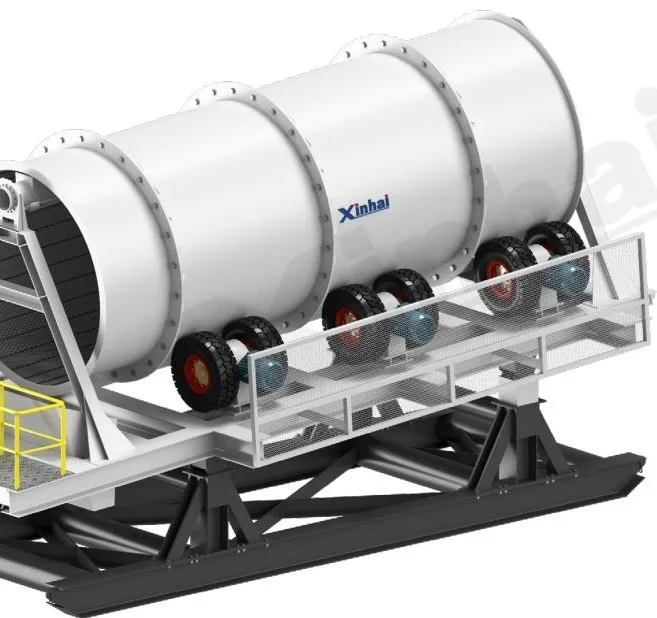
The horizontal dryer handles large-tonnage bulk drying across a wide moisture range. Drum granulators suit continuous pelletizing with a rolling bed and binder addition, while disc granulators deliver tighter size distribution through controlled seed growth on an inclined pan. A plant often pairs a dryer with a granulator.
- Horizontal Dryercat.
- Drum Granulatorcat.
- Disc Granulatorcat.
Names marked cat. follow the equipment handbook rather than the product catalogue naming.
What decides the selection
Start by defining initial and target moisture and the material’s thermal degradation limit; these set the dryer type and residence time. Pellet size distribution and binder regime drive granulator selection, while dust and off-gas handling influence ancillary system design. Bench-scale and pilot tests confirm throughput, pellet strength, and drying curve.
- Initial and target moisture
- Heat sensitivity of the material
- Heat source
- Residence time
- Dust and off-gas handling
- Pellet size distribution
- Binder regime
Machines in this category
36 models across 3 machine types, as published in the Xinhai equipment application manual.
| Machine | Models | Indicative range |
|---|---|---|
| Horizontal Dryer | 8 | Production Capacity (t/h): 6-150 |
| Drum Granulator | 11 | Motor Power (kW): 5.5-30 |
| Disc Pelletizer | 17 | Main Motor Power (kW): 3-160 |
ISO 9001 / ISO 14001 / ISO 45001 / ISO 9712 / CE / CSA W47.1 / CNAS accredited laboratory
Send the duty, get a sized proposal
Tell us the ore, the throughput and the target product. Our process engineers come back with a flowsheet position, a model shortlist and the testwork we would need to confirm it.